What is Project Argus
Many eyes.
One system.
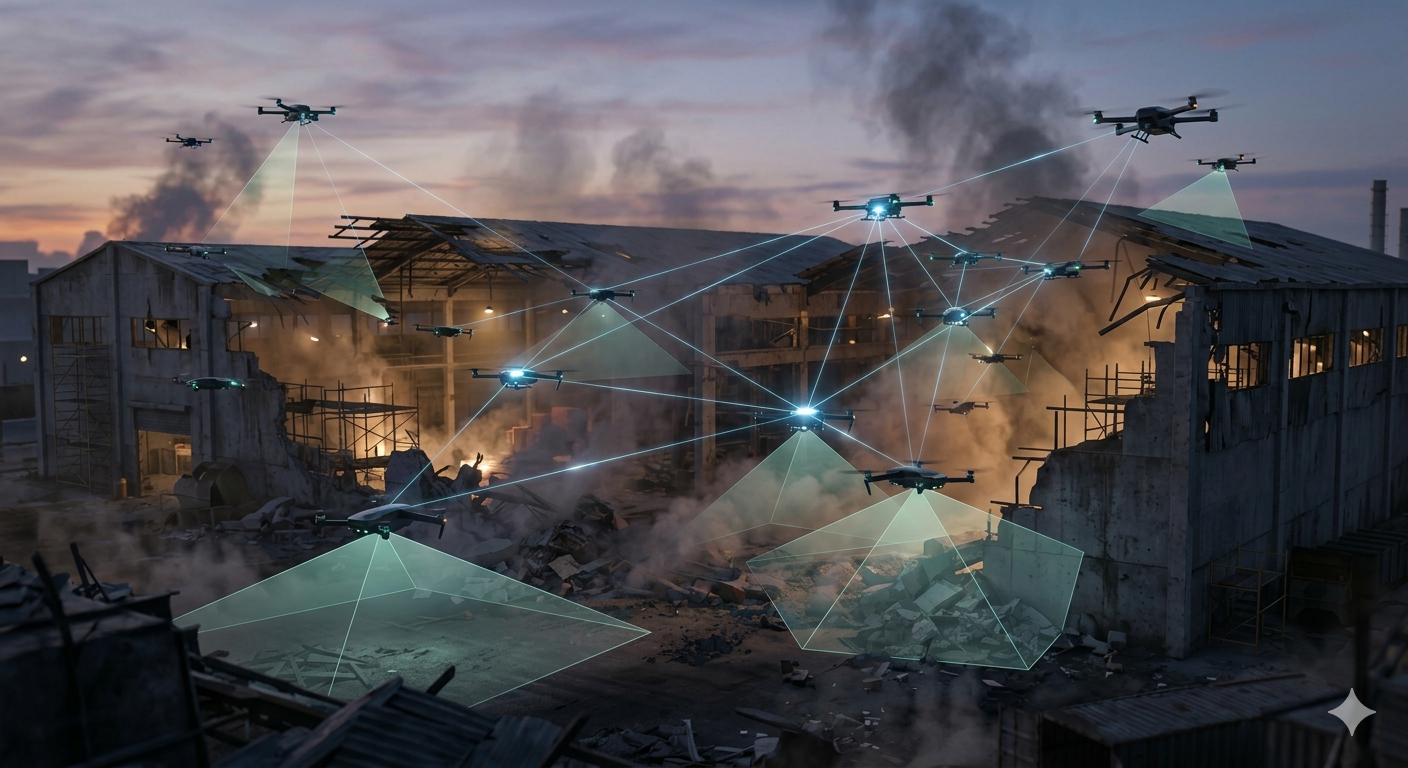
Current drone operations rely on single platforms or demand heavy operator input. Argus distributes the load - pushing intelligence to each agent so the swarm operates as one cohesive network.
⬡
Onboard Autonomy
Each unit operates with real-time local decision-making, adapting to changing conditions without constant human input.
Edge AILocal Control
⇌
Inter-Drone Communication
Resilient protocols allow drones to share state, intent, and environmental data under dynamic and constrained network conditions.
Mesh NetworkProtocol Design
◈
Distributed Sensor Fusion
Observations from multiple agents are combined into a unified, higher-quality picture of the environment than any single unit could achieve.
FusionMulti-agent
⟳
Relay & Network Architecture
Dynamic relay chains extend range and maintain connectivity in environments well beyond direct line of communication.
TopologyRelay Chains
▤
Operator Interface
Complex multi-agent data is transformed into clear, actionable intelligence - reducing cognitive load for non-specialist operators.
UXHCI
◎
Simulation & Validation
Structured testing in constrained simulation environments validates coordination, communication, and coverage strategies before field deployment.
SimulationValidation
In Greek mythology, Argus Panoptes is the hundred-eyed giant - an ever-watchful guardian who could observe in all directions simultaneously. Project Argus draws on that idea: persistent awareness achieved through many coordinated vantage points operating as a single, unified system. Not one observer, but many - indistinguishable from one.
Follow our journey
Stay in the loop as we build
Leave your details and we'll keep you updated on Project Argus developments, milestones, and opportunities to collaborate.
Get Involved
Technology
How Project Argus works
A layered system architecture that moves intelligence from centralised control to distributed edge nodes - enabling the swarm to function even when connectivity is degraded or lost.
01 - Sense
Distributed Perception
Each UAV independently collects environmental data using onboard sensors. No single point of failure, no single field of view.
02 - Decide
Edge Autonomy
Onboard processing allows each unit to make real-time decisions without waiting for a central controller - latency drops, resilience increases.
03 - Share
Mesh Communication
Units broadcast state and intent across a dynamic mesh network. Relay chains extend range into areas with no ground infrastructure.
04 - Understand
Unified Picture
Fused data from all agents is surfaced through a simplified operator interface - one coherent view of a complex, dynamic environment.
R&D Focus Areas
Where the work is happening
Development is structured around six interconnected research areas, each targeting a core challenge in building scalable, resilient autonomous swarm systems.
Area 01
Autonomy & Local Decision-Making
Each UAV runs onboard intelligence enabling context-aware choices based on local sensor input, neighbouring agent state, and mission parameters - without relying on ground station latency.
Current focus: Defining decision-tree architectures for common scenarios including coverage maintenance, obstacle response, and relay duty assignment.
Area 02
Inter-Drone Communication
Communication between agents uses custom protocols optimised for low-bandwidth, high-latency conditions. State sync, intent sharing, and emergency broadcasts are prioritised by criticality.
Current focus: Simulating degraded-network scenarios to harden protocols against dropouts and validate priority queuing behaviour.
Area 03
Distributed Sensor Fusion
Fusing data across agents requires reconciling temporal offsets, positional uncertainty, and varying sensor quality. The result is a shared environment model no single agent could construct alone.
Current focus: Probabilistic fusion methods and consensus algorithms that degrade gracefully as agent count changes.
Area 04
Relay & Network Architecture
Dynamic formation of relay chains allows the network to extend far beyond direct communication range. Units can automatically adopt relay roles based on network topology and agent availability.
Current focus: Topology management under agent loss and real-time relay re-assignment without service interruption.
Area 05
Operator Interface
A 12-agent swarm generates enormous data throughput. The operator interface compresses this into intent-level awareness - showing what matters, when it matters, without overwhelming non-specialist users.
Current focus: Alert hierarchy design, map-overlay abstractions, and cognitive load measurement through user testing.
Area 06
Simulation & Validation
Before any hardware flies, behaviours are validated in constrained simulation environments that model communication dropout, environmental obstacles, and agent failure modes at scale.
Current focus: Building repeatable test scenarios for coordination, relay formation, and coverage under adversarial conditions.
Want to go deeper?
We're actively seeking research partners and technical collaborators. Reach out to start a conversation.
Contact Us
Products
What we're building
Project Argus is developing an integrated system - hardware platforms, software stack, and operator tools - designed to work together from the ground up.
● In Development
Argus Node UAV Platform
The core hardware unit of the Argus swarm. Designed for modularity, edge computing, and inter-agent communication in constrained environments. Each node is both a sensor and a network participant.
RoleSensing / Relay / Command
ArchitectureEdge AI + Mesh Radio
StageArchitecture Design
Target Swarm Size4–24 units
Argus Node
Concept render pending
○ Planned
Argus Mesh Protocol
A resilient inter-drone communication stack purpose-built for constrained, dynamic environments. Handles state sync, intent broadcasting, and relay chain management with configurable priority queuing.
TypeSoftware / Firmware
Latency TargetSub-100ms local
StageSimulation Testing
○ Planned
Argus Ground Station
Operator-facing software that translates complex multi-agent telemetry into clear situational awareness. Designed for non-specialist users operating under time pressure in the field.
TypeSoftware - Desktop / Tablet
InterfaceMap-centric + Alert Layer
StageUX Research
Partnership
Interested in co-developing?
We're open to hardware, software, and integration partnerships across all product lines.
Get in Touch
Solutions & Use Cases
Where Argus operates
Argus is designed for environments where visibility is limited, coordination is critical, and a single platform is not enough. These are the scenarios driving our R&D priorities.
01
Search & Rescue in Obstructed Terrain
Coordinated agents navigate dense forest, collapsed structures, or complex built environments where traditional aerial observation is limited. Coverage is maintained even as individual units lose signal.
02
Hazardous Environment Assessment
Remote inspection of fire-damaged buildings, industrial sites, or contaminated zones - no personnel at risk. The swarm maps, assesses, and reports without human entry.
03
Persistent Area Monitoring
Continuous awareness over a defined zone through coordinated coverage and dynamic repositioning. No gaps, no blind spots, no single point of failure.
04
Remote & Low-Connectivity Operations
Relay-based communication extends operational reach into areas with no ground infrastructure. Argus functions where connectivity is a constraint, not an assumption.
05
Emergency Response Support
Real-time situational awareness delivered to response teams during critical incidents - enabling faster, more informed decision-making under pressure.
06
Adaptive Network Expansion
New agents integrate seamlessly into existing operations, extending coverage or opening new areas of interest without redeploying the entire system from scratch.
Common Thread
The pattern across all scenarios
Every use case above shares the same underlying challenge: a single platform cannot cover enough ground, maintain persistent presence, or survive the loss of connectivity on its own. Argus solves this not by making any one drone better, but by making many drones operate as one - distributing sensing, computation, and communication across the network so the system as a whole is resilient even when individual nodes are not.
Have a specific use case in mind?
We're exploring applications across defence, emergency services, infrastructure, and industrial sectors. Let's talk.
Start a Conversation
Get Involved
Let's build this together
Whether you're a potential partner, investor, researcher, or just want to follow along - we'd love to hear from you.